Try Fail Try Again Fail Better Try Fail Try Again Fail Better Samuel Beckett
Samuel Beckett: Fail Improve and "Worstward Ho!"
Today we're featuring a Samuel Beckett quote that has gained immense popularity in recent years. You may not have known that this quote comes from Irish gaelic author Samuel Beckett, merely there'southward no uncertainty y'all know the words.
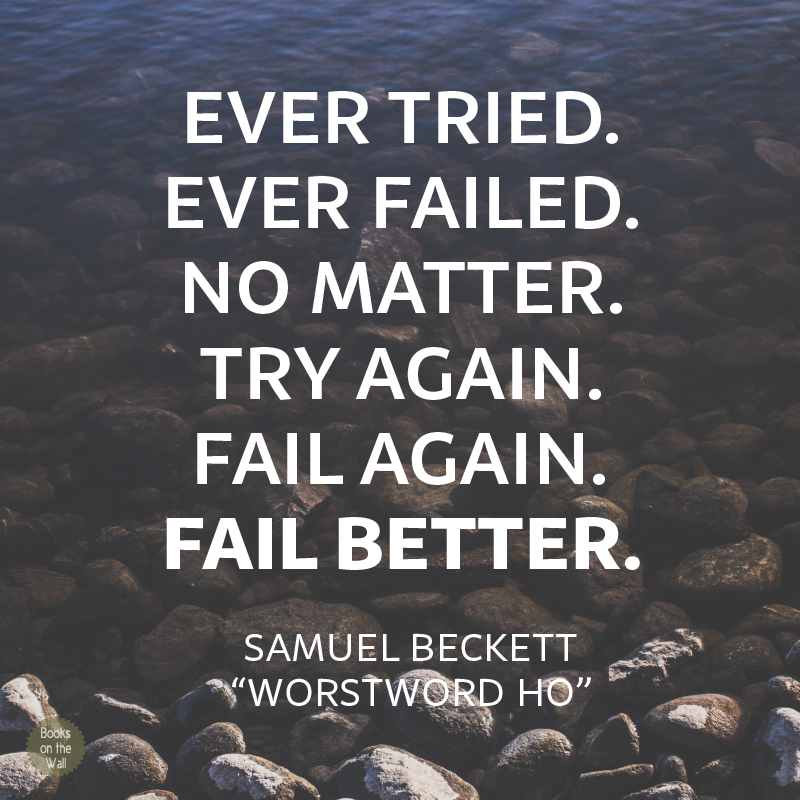
Even if you aren't involved in tech, entrepreneurship, lifehacking, or other such digital-age ubiquities, you've probably heard the nigh famous part of this Samuel Beckett quote: "Fail amend."
The "Neglect Improve" Quote by Samuel Beckett
The "fail amend" quote was originally published in Samuel Beckett's short piece of prose entitled Worstward Ho!, his second-to-final piece of work ever published. The total Samuel Beckett quote reads like this (and by "full," nosotros actually mean the part that gets repeated):
"Ever tried. Ever failed. No matter. Try again. Fail once more. Fail better."
By itself, you can probably understand why this phrase has go a mantra of sorts, particularly in the glamorized world of overworked offset-upward founders hoping against pretty loftier odds to make information technology.
Even outside of the concern evolution niche, this quote does sound inspiring. Right?
We recollect so, as well. That is…until you read the rest of it.
Is the "Fail Amend" Quote Really Inspirational?
Here's the continuation of that Samuel Beckett quote, the part that immediately follows the famously catchy flake (our emphasis added):
"First the body. No. First the place. No. Offset both. Now either. Now the other. Sick of the either try the other. Sick of it back sick of the either. And so on. Somehow on. Till sick of both. Throw up and go. Where neither. Till ill of there. Throw upward and back. The body again. Where none. The place again. Where none. Try once again. Fail again. Better again. Or better worse. Neglect worse once again. Notwithstanding worse once more. Till sick for skilful. Throw up for good. Go for good. Where neither for good. Adept and all."
As this markedly darker snippet of text demonstrates, Worstward Ho! seems to have nada to do with positivity, motivation, or progress.
In fact, information technology seems that the only recompense Beckett's narrator can come up with for the absurdity of beingness is to "fail better" the side by side fourth dimension.
Not exactly inspiring, correct?
The Meme-ification of the "Fail Meliorate" Samuel Beckett Quote
In Beckett'south bleak worldview, life is already a thousand failure (or a tragi-one-act, if yous'd adopt) in which we are all, like the narrator ofWorstward Ho!, sitting in an inexplicable "dim void." The fact that this Samuel Beckett quote has been taken so far from its original roots is pretty fascinating.
Marking O'Connell, a author forSlate, describes the ironic meme-ification of the "fail meliorate" quote like this:
"The entrepreneurial way for failure with which this polished shard fits so snugly is not really concerned, as Beckett was, with failure per se—with the necessary defeat of every homo endeavor, of all efforts at communication, and of language itself—but with failure as an essential stage in the individual's progress toward lucrative self-fulfillment."
As O'Connell notes, Samuel Beckett was interested in failure, full stop. Non failure as a necessary path toward riches, or fame, or (anybody's favorite buzzword) "innovation." Just failure.
The "Dim Void:" Beckett'sWorstward Ho!
Except for this 1 "fail improve" quote, nearly every other snippet fromW Ho! reflects the real Samuel Beckett: brooding, morbid, and completely avant-garde.
Indeed, far from encouraging techie CEOs to attain their greatest potential, Beckett'due south principal obsession inWestward Ho! is "the void":
"Longing that all go. Dim go. Void go. Longing become. Vain longing that vain longing go."
In many ways, this text can be seen every bit an extended meditation on the inexplicable nature of being and not-existence. Beckett's narrator seems to be trying to work out the paradox of emptiness and presence, of nativity and death.
Worstward Ho! vs. Westward Ho!
The title ofWorstward Ho! is a riff on the 19th century novelWestward Ho! by the English novelist Charles Kingsley, offering a very contrasting view of life.
While the phrase "Westward Ho!" is associated with expansion, growth, and swell optimism for the futurity, Beckett's title reminds us that, ultimately, we are all journeying "worstward" towards the grave…
…and possibly back again. It'south not quite articulate, only some people encounter the theory of reincarnation in this work, just as "metempsychosis" is a major theme in Joyce'sUlysses.

Receive the 8 Best Literary Stories, Every Week
Want the top bookish content from across the internet? Bring together our Weekly Literary Roundup to receive the most popular and relevant literary news every Tuesday at 10 am.
Unreliability of Linguistic communication
Another important theme inWorstward Ho! (again, something skipped over in the famous Samuel Beckett quote) is the narrator's lack of faith in language. Afterwards in the piece, Beckett writes the following:
"With leastening words say least best worse. For want of worser worse. Unlessenable least best worse."
This phrase succinctly encapsulates Beckett's later minimalist aesthetics. Y'all tin can also run across the unreliability of language equally "word" about slips into "worse" in this quote.
What DoesWorstward Ho!Even Mean?
A few literary critics have tried to allocateWorstward Ho! as a novella, but information technology's quite hard to make out a clear plot in this text. Readers who support the theory thatWorstward Ho! is a novella point out that this text is mainly about an old human, an erstwhile adult female, and a kid visiting a graveyard. It's left up to usa, perhaps, to fill in the blanks surrounding these three figures.
Every bit with many of Beckett's other works, in that location'due south a great deal of disagreement over whatWorstward Ho! actually "means." The adult female, man, and child might be symbolic of stages in the human condition. Or they might not.
As with any other piece of work of fiction, readers only get out of Beckett's text as much equally they put into it.
Samuel Beckett: And then Much More Than "Neglect Better"
A Nobel Prize-winning writer, Samuel Beckett's been called many things: Avant-garde. Night. Intense. Depressive.
But inspiring? Not so much.
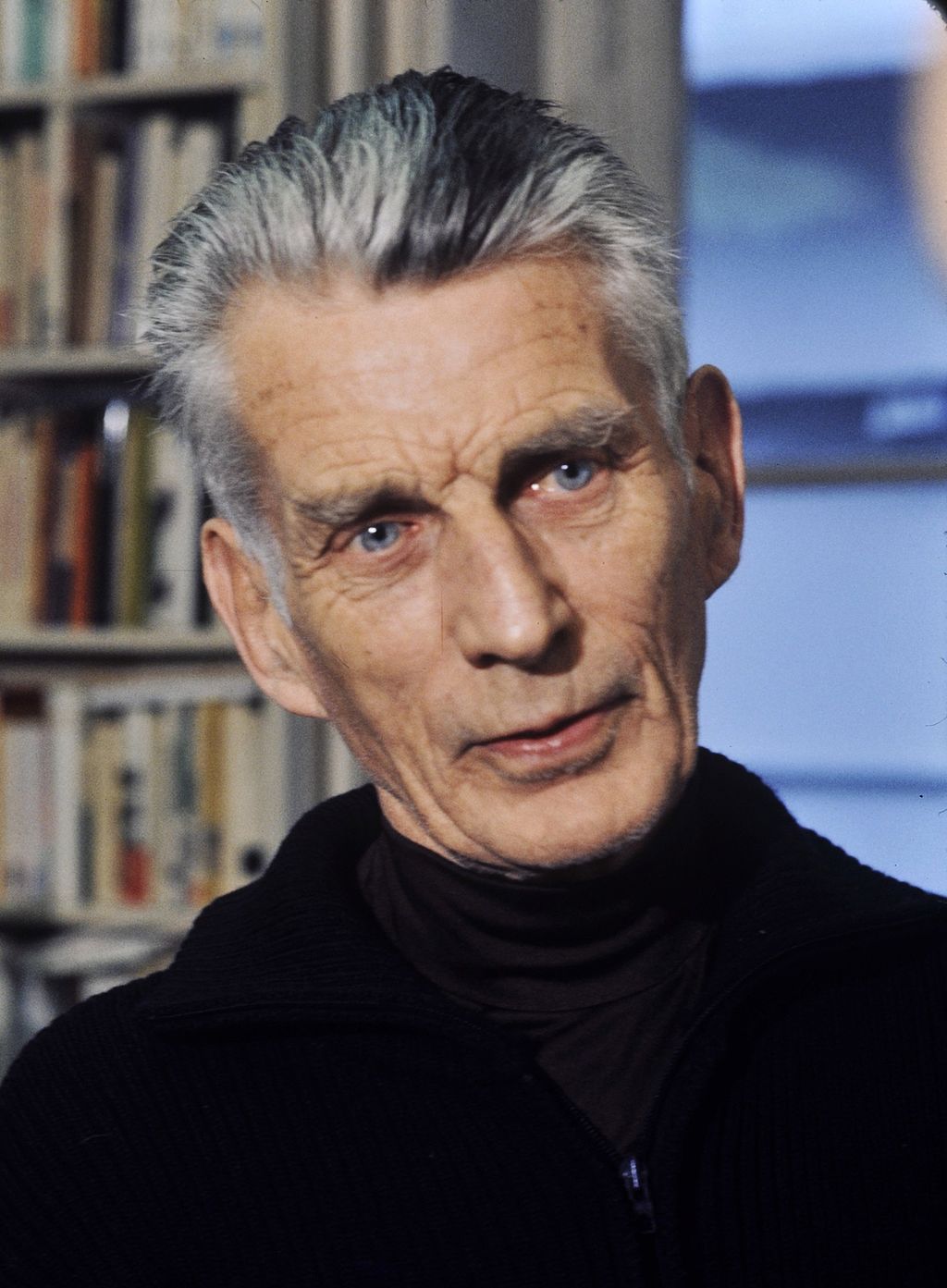
Samuel Beckett Portrait [Public Domain], via Wikimedia Commons
In fact, Morris Dickstein at The New York Times Volume Review says this of Beckett's life and piece of work:
"He arrived early on at an extremely bleak view of life and a sense of the peculiarity of his own detached and morbid temperament."
To understand more most this famous Irish writer—and see what's beyond his out-of-context "fail meliorate" quote—let'due south have a little deeper look at his life.
Friendship with Joyce and WWII
Samuel Beckett was born in 1906 in Dublin and was raised in a Protestant household.
After receiving his BA in Romance languages at Trinity College, Beckett moved to Paris where he became shut friends with young man Irish writer James Joyce. Beckett learned a great bargain about writing from Joyce and helped the swell writer with his last novelFinnegans Wake.
When World War 2 broke out, Beckett remained in France and worked with resistance fighters. For his efforts, Beckett was awarded the Croix de Guerre from the French government in 1945. Earlier the war, Beckett mainly wrote essays on literary criticism. The simply piece of work from this flow students read today is Beckett's analysis of French author Marcel Proust.
Avant-garde Theater and Literary Development
Virtually literary historians agree that Beckett's showtime great novel wasWatt, which was published in 1953. Beckett then published a major trilogy of novels chosenMolloy,Malone Dies, andThe Unnamable.
Only it wasn't until he produced his classic absurdist drama Waiting For Godotthat Beckett became a celebrity of Avant-Garde theatre.
Beckett spent the rest of his life generally moving between the Marne Valley and Paris. He was a famously reclusive author who rarely gave interviews, although he was generous with his fourth dimension for serious artists that sought him out.
As he matured, Beckett tried to parse downwardly his prose to the bare essentials. In fact, some of Beckett's later works (like the 30-second play "Breath") had no words at all.
Beckett'south style of prose went in the exact opposite of his mentor James Joyce. Whereas Joyce'south works expanded over time, Beckett's afterwards texts had fewer and fewer words. A few of the keen works from his middle and tardily career include:
- Endgame
- Eh Joe
- Krapp'southward Last Record
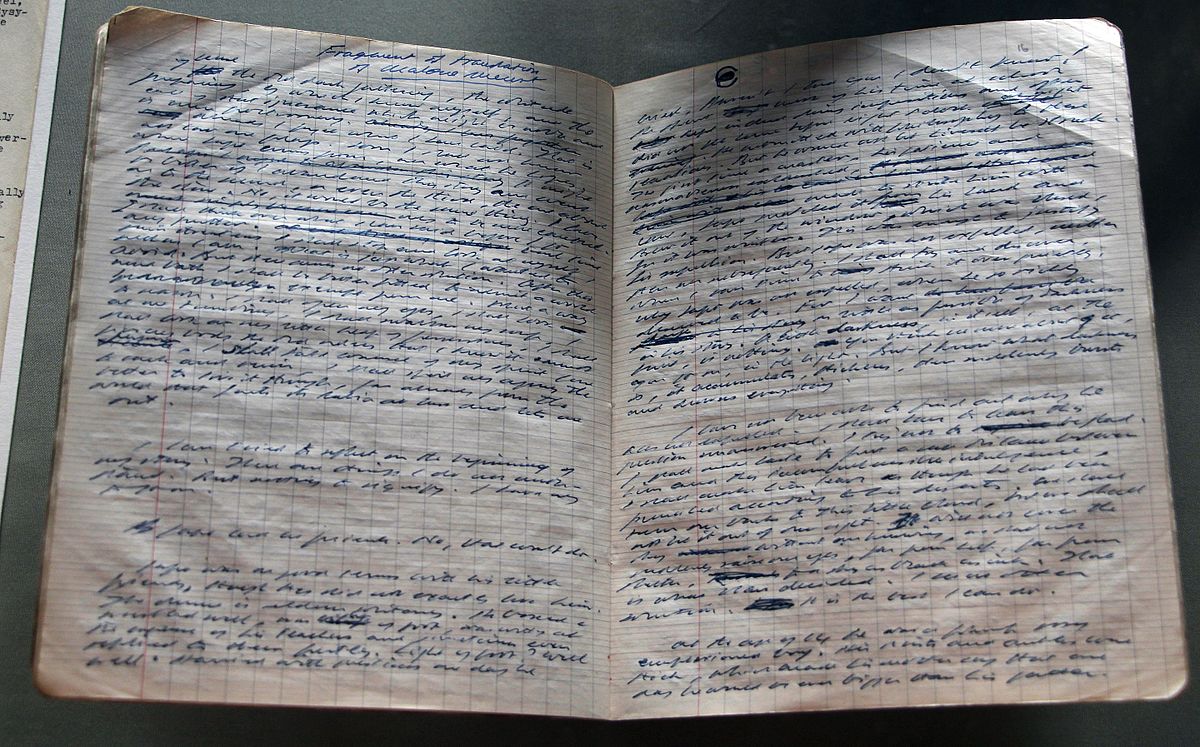
Manuscript of Embers, a comedy radio play by Samuel Beckett, past Dmitrij Rodionov, via Wikimedia Eatables
Nobel Prize in Literature and Later on Life
The Nobel Prize Committee awarded Beckett the Nobel Prize in Literature in 1969. Although he accepted the award, he didn't brand a speech and he generously gave away all of his prize money.
Beckett passed abroad in 1989, just a few months after his wife Suzanne Déchevaux-Dumesni. The two were buried in the French capital'south famous Cimetière de Montparnasse.
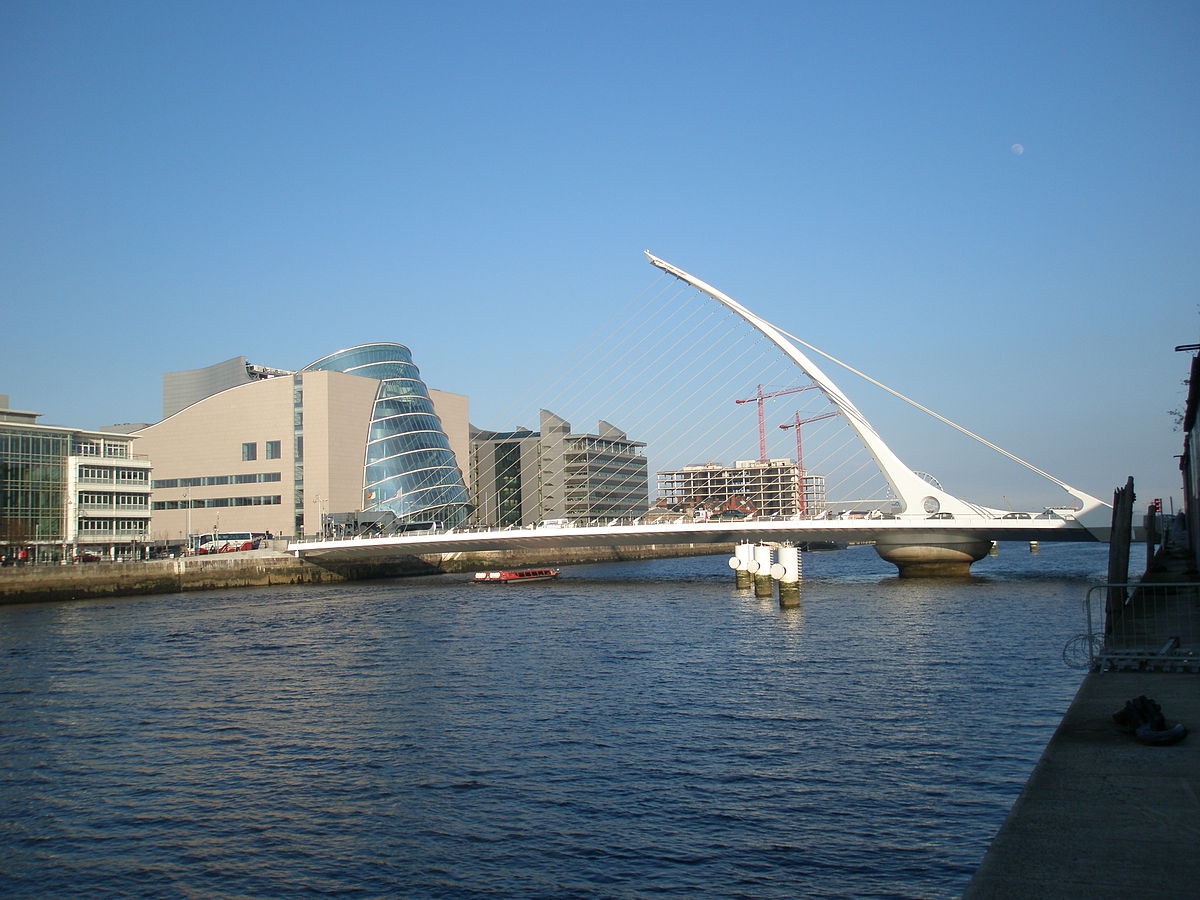
Samuel Beckett Bridge, Dublin, by Surrell, via Wikimedia Commons
To honor the great writer, Parisian officials (perhaps ironically) named the Allée Samuel Beckett virtually the infamous Catacombs in his laurels. In 2007, Dublin besides honored the influential writer with the Samuel Beckett Bridge over the River Liffey.
Mostly all of Beckett's works explore heavy themes:
- Death
- Retentivity
- Linguistic communication's relationship to reality
Although Beckett is often seen equally a morbid writer, he often injects his own unique sense of Irish gaelic humor into many of his plays and novels. Much similar Joyce's work, many of Beckett's texts are full of references to some of his favorite authors in the Western literary canon, especially Dante Alighieri.
Connections Betwixt Beckett and Dante
Beckett was a great admirer of Dante's poetry. It's even possible that Beckett had the terminal lines ofParadiso in mind when he composed some sections ofWorstward Ho!
As Dante stands before God in the finale to his grand epic, he utters these unforgettable verses:
Hither force failed my high fantasy; merely my
Desire and will were moved already—like
A bike revolving uniformly—by
The Dearest that moves the lord's day and the other stars.
For Dante, as information technology seems for Beckett also, the highest happiness is to surrender all craving and, at least in Dante'south vision, to permit God to work through us. Dissimilar Dante, however, Beckett is living after the horrors of World War 2 and after the Nietzschean "Decease of God."
Merely like us, Beckett is in an age far removed from the faith of the Centre Ages that inspired the soaring cathedrals all across Europe. Indeed, instead of building the grand cathedrals, nosotros are living amid their rubble. With these immense suffering of World War Ii at the forefront of his listen, Beckett suggests that there's niggling to be hopeful for in the atomic age.
Interestingly, despite all of his cynicism about the human condition, there is nevertheless a faint desire in Beckett's piece of work for spousal relationship with the divine.
Tips for Further Study ofWorstward Ho!
Beckett'due southWorstward Ho! is extremely rhythmic and relies on brusk staccato sentences.
When you heed to thisprose-poem, information technology about sounds like an incantation and tin have a hypnotic effect. If you do make up one's mind to listen to this text from a trained reader, then you will want to hold a copy of the verse form in your paw to keep track of Beckett's wordplay.
A few words Beckett switches effectually in the piece include the pairs "know"/"no" and "2"/"too." Also, afterward in the text, Beckett uses the give-and-take "prey," which could exist mistaken for "pray" if you're just listening to the poem.
There are many excellent readings ofWorstward Ho! online. Yous can likewise observe Beckett's originalWorstward Ho! text alongside helpful glosses by Colin Greenlaw on this webpage.
"Neglect Improve": What Does It All Mean?
Hither at Books on the Wall, nosotros love digging into quotes and all things quote related—from what work the quote came from, what the author meant by information technology, how modern society has interpreted it, and whether the supposed author even wrote the quote in the offset place.
When you start looking deeper into the many quotes that float effectually our commonage conscience and the net (and in this case, on tennis role player Stan Wawrinka'southward tattooed arm), you lot'll see pretty quickly that there's always more to the story than the piddling chip of text that happened to become famous.
And by at present, you'll realize that this is definitely true of this particular Samuel Beckett quote.
And this all raises an interesting question: Does a quote's context affair?
If not for the misplaced fame of this Samuel Beckett quote, tons of people would never have even heard of this groundbreaking Irish author. Plus, it could be argued that—despite its undisputed out-of-contextness—the "neglect amend" quote has truly inspired people, perhaps fifty-fifty changed lives.
And so does it matter that its writer would probably blench to learn how commercialized and, well, positive information technology'south become? How much should an author's original intent color our view of his or her words?
In the end, we really don't know. Information technology's certainly an interesting question to consider.
What exercise you think? Allow us know your thoughts in the comments below.

Receive the 8 Best Literary Stories, Every Week
Want the top bookish content from across the internet? Join our Weekly Literary Roundup to receive the nigh pop and relevant literary news every Tuesday at 10 am.
Recommended For You
Source: https://booksonthewall.com/blog/samuel-beckett-quote-fail-better/
0 Response to "Try Fail Try Again Fail Better Try Fail Try Again Fail Better Samuel Beckett"
Post a Comment