Everything You Need to Know About Us History Middleschool
A middle school (also known as intermediate school, junior high school, or lower secondary school) is an educational stage which exists in some countries, providing education between principal school and secondary schoolhouse. The concept, regulation and classification of eye schools, as well as the ages covered, vary between and sometimes within countries.
Afghanistan [edit]
In Transitional islamic state of afghanistan, centre school includes grades 6, 7, and 8, consisting of students from ages 11 to 14.
Algeria [edit]
In Algeria, a centre school includes iv grades: half dozen, 7, 8, and nine, consisting of students from ages xi–15.
Argentina [edit]
The ciclo básico of secondary education (ages xi–14) is roughly equivalent to center school.
Australia [edit]
No regions of Australia have segregated middle schools, as students become directly from primary schoolhouse (for years One thousand/preparatory–6) to secondary school (years 7–12, usually referred to equally high school).[1]
As an alternative to the center school model, some secondary schools classify their grades equally "eye school" (years 5,6,7,8 where master and secondary campuses share facilities or 7,8,9 in a secondary campus) or "inferior high school" (years 7, 8, 9, and 10) and "senior high school" (years eleven and 12). Some have three levels, "junior" (years vii and 8), "intermediate" (years ix and ten), and "senior" (years 11 and 12). Some schools run a specialised twelvemonth 9 program segregated from the other secondary year levels.
In 1996 and 1997, a national conference met to develop what became known equally the National Heart Schooling Project, which aimed to develop a common Australian view of
- early adolescent needs
- guiding principles for educators
- advisable strategies to foster positive adolescent learning.
The first eye school established in Australia was The Armidale School,[2] in Armidale (approximately 370 km (230 mi) north of Sydney, 360 km (220 mi) SSW of Brisbane and approximately 140 km (87 mi) due west of Coffs Harbour on the coast). Other schools accept since followed this trend.
The Northern Territory has introduced a three tier system featuring Middle Schools for years 7–9 (approximate age 13–fifteen) and high school year 10–12 (approximate age 16–18).[3]
Many schools across Queensland accept introduced a Heart Schoolhouse tier within their schools. The middle schools cover years five to 8.[ citation needed ]
Bangladesh [edit]
In Bangladesh, middle school is not separated as in other countries. Generally, schools are from form one to class 10. It means lower principal (i–5), upper primary (6–x). Course 6–8 is thought of every bit middle school. Grades one,two,3,4 and 5 are said to be primary school while all the classes from half-dozen to 10 are considered loftier school (every bit center school and high schoolhouse are not considered separate) while 11–12 (inclusive) is chosen higher.
- i–5 is known as primary (Part of Main School)
- 6–8 is known every bit lower secondary (Part of High School)
- 9–10 is known every bit secondary (part of High School)
- eleven–12 is known as college secondary also known as higher.
Bolivia [edit]
Middle schools in Republic of bolivia take been abolished since 1994.[4] Students aged xi–15 attend the concluding years of elementary didactics or the first years of secondary education.
Bosnia and herzegovina [edit]
In Republic of bosnia and herzegovina "heart school" refers to educational institutions for ages between xiv and eighteen, and lasts three–4 years, following uncomplicated school (which lasts 8 or 9 years). "Gymnasiums" are the near prestigious type of "middle" schoolhouse.
Brazil [edit]
In Brazil, heart schoolhouse is a mandatory stage that precedes High School ( Ensino Médio ) called "Ensino Key 2" consisting of grades 6 to 9, ages 11 to 14.
Canada [edit]
In Canada, the terms "Middle School" and "Junior High School" are both used, depending on which grades the school caters to.[5] Junior high schools tend to include simply grades 7, 8, and sometimes 9 (some older schools with the name 'carved in physical' yet use "Junior Loftier" as office of their proper noun, although course 9 is at present missing), whereas center schools are usually grades 6–8 or only grades 7–viii or 6–7 (i.e. around ages 11–14), varying from area to area and also according to population vs. building capacity.
Another common model is grades 5–8. Alberta, Nova Scotia, Newfoundland, and Prince Edward Isle junior high schools typically include grades 7–ix, with the offset twelvemonth of high schoolhouse traditionally beingness grade 10. In some places students go from unproblematic schoolhouse to secondary school, meaning the uncomplicated school covers to the terminate of grade viii.
In Ontario, the term "Middle Schoolhouse" and "Senior Public School" (sometimes just grades 7 and 8) are used, with the latter being used especially in the Quondam Toronto and Scarborough sections of Toronto plus in Mississauga, Brampton, and Kitchener-Waterloo. In many smaller Ontario cities and in some parts of larger cities, nearly elementary schools serve inferior kindergarten to grade eight meaning in that location are no separate Middle Schools buildings, while in some cities (such as Hamilton) specific schools do serve the intermediate grades (i.due east. Grades vi–8 or Grades 7–viii) but are still chosen "Elementary" or "Public" schools with no recognition of the grades they serve in their name.
Quebec uses a grade organisation that is unlike from those of the other provinces. In Quebec, there is no Middle school section. The Secondary level has five grades starting after Simple Form six. These are called Secondary I to Secondary Five.
Chile [edit]
Chile does not accept heart schools, they instead have educacion basica that teaches basic education like elementary school, and educacion media, which is middle education like middle schoolhouse or loftier school. Educacion basica is from 1st grade to 6th class, and educacion media from 7th class to twelfth grade. Communities do not consider the 7th and 8th grades being role of educacion media despite the government rendering it, communities care for the grades as middle school.
China [edit]
In the People's Republic of China, chief school covers grades 1–6 and secondary school covers grades 7–12. Secondary schools are further divided into two stages, junior high school ( 初级中学 chūjízhōngxué or 初中 chūzhōng , grades 7–9) and senior high school ( 高级中学 gāojízhōngxué or 高中 gāozhōng ), grades 10–12). The Chinese inferior high schoolhouse is roughly equivalent to an American middle school, and provides the final 3 years of the nine-year compulsory instruction required for all Chinese citizens. The senior high schoolhouse is optional but considered as critical preparation for tertiary education.
The admissions for nearly students to enrol in senior secondary schools from the inferior stage are on the basis of the scores that they become in "Senior High School Archway Exam",[note 1] which are held by local governments. Other students may featherbed the exam, based on their distinctive talents, similar athletics, leadership merits or splendid coursework functioning in junior stage.
Colombia [edit]
Secondary teaching is divided into basic secondary (grades 6 to 9) and mid-secondary (grades 10 and 11). The students in basic secondary, roughly equivalent to heart schoolhouse, are 11 or 12 to 15 or 16 years old.
Croatia [edit]
In Croatia "middle school" refers to educational institutions for ages betwixt 14 and 18, and lasts 3–five years, following elementary school (which lasts 8 years). "Gymnasiums" are the most prestigious type of "middle" school.
Republic of cuba [edit]
Secundaria básica (basic secondary, seventh through ninth grades) is the gauge equivalent of eye school in Cuba.
Czech Republic [edit]
In the Czechia after completing the ix-twelvemonth elementary school (compulsory school omnipresence) a educatee may apply for loftier school or grammar school.[6]
Students have the opportunity to enroll in high school from Grade 6 or (less normally[ citation needed ]) Grade 8 of elementary school, spending eight or six years respectively at high schoolhouse that otherwise takes four years. Thus they tin can spend five years in elementary schoolhouse, followed past eight in loftier school. The first four years of the eight-year study program at high school are comparable with junior high schoolhouse.[ commendation needed ] Gymnasium focuses on a more avant-garde academic arroyo to instruction.[ citation needed ] All other types of high schools except gymnasiums and conservatories (due east.1000. lyceums) have just students that finished Class 9.[half dozen]
Ecuador [edit]
The 4th and concluding level of educación general básica (ages 12–14) is roughly equivalent to middle schoolhouse.
Arab republic of egypt [edit]
In Egypt, middle schoolhouse precedes high schoolhouse. It is called the preparatory stage and consists of 3 phases: beginning preparatory in which students study more subjects than primary with dissimilar branches. For instance, algebra and geometry are taught instead of "mathematics." In the second preparatory phase, students study science, geography, the history of Arab republic of egypt starting with pharaonic history, including Coptic history, Islamic history, and terminal with modern history. The students are taught ii languages, Arabic and English. Heart schoolhouse (preparatory stage) lasts for iii years.
France [edit]
(2006)In French republic, the equivalent period to middle school is collège, which lasts four years from the Sixième ("sixth," the equivalent of the Canadian and American Class 6) to the Troisième ("third," the equivalent of the Canadian and American Form 9), accommodating pupils aged betwixt 11 and xiv. Upon completion of the latter, students are awarded a Brevet des collèges if they obtain a certain number of points on a serial of tests in diverse subjects (French, history/ geography, mathematics, science/physics/chemistry), just also on a series of skills completed during the last twelvemonth and on oral examinations (e.1000. about cross-subjects themes they work on the latest years, the fourth year of collège). They tin can then enter high schoolhouse (called lycée ), which lasts three years from the Seconde to the Terminale until the baccalauréat , and during which they can choose a full general or a professional person subject field.[7]
Georgia [edit]
In Georgia, the equivalent period to center school covers ages 12 to 15, from the 7th grade to the 10th and guarantees basic educational degree certificate.[8]
Gibraltar [edit]
There are 4 eye schools in Gibraltar, post-obit the English model of middle-deemed-master schools accommodating pupils aged between 9 and 12 (National Curriculum Years four to vii). The schools were opened in 1972 when the government introduced comprehensive education in the territory.[9]
Greece [edit]
In Greece, the equivalent menstruation to centre schoolhouse is called γυμνάσιο ( gymnasio ), which caters to children between the ages 12 and xv, i.e. seventh, 8th, and ninth grade.
India [edit]
In India, Middle School is classified as Upper Chief (Class 6–eight).[10] Each state has its ain Land Lath. Each has its ain standards, which might be different from the Central Boards.[10] In some institutions, providing instruction for 5th to 10th is known every bit a secondary schoolhouse.[ten]
The levels of education in India are:
- Pre-Principal – Nursery to KG
- Primary (Lower Principal) – Classes I to Five
- Centre School (Upper Main) – Classes VI to VIII
- High school – Classes IX to 10
- Higher Secondary (PUC or Plus Two) – Classes XI to XII
Indonesia [edit]
In Indonesia, centre school (Indonesian: Sekolah Menengah Pertama, SMP) covers ages 12 to 15 or grade 7 to form 9.
Although compulsory education ends at junior loftier, most pursue college education. There are effectually 22,000 eye schools in Republic of indonesia with a balanced ownership between public and private sector.[11]
Iran [edit]
Iran calls Middle School Guidance Schoolhouse, which caters to children between the ages 12 and xv, i.due east. sixth, 7th and 8th grade.[12]
State of israel [edit]
In most of the cities in Israel, centre school (Hebrew: חטיבת ביניים, Khativat Beynaiym ) covers ages 12 to 15. From the seventh grade to the 9th.[thirteen]
Italian republic [edit]
In Italian republic the equivalent is the scuola secondaria di primo grado formerly and commonly called lower middle school ( Scuola Media Inferiore ), oft shortened to middle school ( Scuola Media ). When the Scuola secondaria di secondo grado , the equivalent of high school, was formerly chosen higher center school ( superiori ), commonly called Superiori. The Centre School lasts three years from the student age of 11 to age 14. Since 2009, afterward Gelmini reform, the middle school was renamed Scuola secondaria di primo grado (junior secondary schoolhouse).
Jamaica [edit]
Middle school in Jamaica is called "Junior High Schoolhouse." It is from class 7–nine but this idea is becoming rare now so these grades are considered lower secondary.
(They too have a master school (grades 1–vi)
Japan [edit]
Junior loftier schools ( 中学校 chūgakkō ) are for children aged twelve through fifteen years quondam.
Kosovo [edit]
In Kosovo "eye school" refers to educational institutions for ages between 14 and eighteen, and lasts 3–iv years, following elementary school (which lasts 8 or 9 years). "Gymnasiums" are the most prestigious type of "eye" school.
Kuwait [edit]
In Kuwait, middle school is from course half dozen–ix and from historic period 11–14.
Lebanon [edit]
In Lebanese republic, middle school or intermediate school consists of grades 7, eight, and ix. At the stop of 9th grade, the student is given the National diploma examination.
North Republic of macedonia [edit]
In North Macedonia middle school refers to educational institutions for ages between xiv and 18, and lasts 3–iv years, post-obit uncomplicated school (which lasts viii or 9 years). "Gymnasiums" are the most prestigious type of middle school.
Malaysia [edit]
In Malaysia, the middle school equivalent is chosen lower secondary school which consists of students from historic period 13 to fifteen (Course ane–iii).[note 2] Commonly, these lower secondary schools are combined with upper secondary schools to class a single secondary school which is besides known as high school. Students at the end of their lower secondary studies are required to sit down for an test called PT3 (Form 3. vii subjects for not-Muslim students and 8 subjects for Muslim students) in gild to determine their field of studies for upper secondary (Course 4–five).[ commendation needed ]
Mexico [edit]
In Mexico, the middle schoolhouse organisation is called Secundaria and unremarkably comprises 3 years, grades 7–ix (ages: 7 12–thirteen, 8 thirteen–fourteen, 9: 14–15). It is completed later Primaria (Elementary School, up to form 6: ages half dozen–12) and earlier Preparatoria/Bachillerato (High School, grades 10–12 ages 15–eighteen).
Montenegro [edit]
In Montenegro middle school refers to educational institutions for ages between xiv and xviii, and lasts 3–iv years, following elementary school (which lasts 8 or nine years). "Gymnasiums" are the nearly prestigious type of "center" school.
New Zealand [edit]
In New Zealand centre schools are known as "intermediate schools." They by and large cover years 7 and viii (formerly known as Forms 1 to 2). Students are generally aged betwixt 10 and 13. In that location are full master schools which also contain yr seven and 8 with students standing to secondary school at twelvemonth 9 (formerly known as Grade 3).[14] Some secondary schools also include years seven and eight.[15] [ citation needed ]
After 2000 at that place was an increased interest in centre schooling (for years 7–10) with at least seven schools offer education to this age grouping opening around the country in Auckland, Cambridge, Hamilton, Christchurch and Upper Hutt.[xvi] [17] [ citation needed ]
Pakistan [edit]
In Pakistan, middle school is called Secondary School and is from Course 6- 10. This covers both the traditional centre and loftier school. Although for individual schools information technology may be different
Peru [edit]
In that location aren't heart schools in Peru. Students aged 12 to xvi attend the five years of educación secundaria (secondary schoolhouse.)
Philippines [edit]
Since the implementation of the K–12 education system, middle school instruction in the Philippines is called "Junior High School." Information technology lasts for 4 years from Grades 7 to x for students age 12 to 16. Some schools, such as Miriam College in Loyola Heights as well as Lourdes School of Quezon City in Sta. Mesa Heights, accept their Middle Schools from Grades 6 to viii. It is preceded by a half-dozen-year elementary school and followed past a 2-year "senior high school" program.
Earlier that, there were no official middle school programs implemented and the equivalent years was just called "High School" which ranged from First Year to Fourth Twelvemonth.
Poland [edit]
Middle schoolhouse in Poland, called gimnazjum , was first introduced in 1932. The educational activity was intended for pupils of at to the lowest degree 12 years of age and lasted iv years. Middle schools were office of the educational organization until the reform of 1947, except during World War 2.
The eye schools were reinstated in Poland in 1999 now lasting three years subsequently six years of primary school. Pupils entering gimnazjum are commonly thirteen years old. Middle school is compulsory for all students, and it is besides the final stage of mandatory education. In the terminal year students take a standardized examination to evaluate their academic skills. College scorers in the examination are immune first pick of schoolhouse if they desire to continue their education, which is encouraged.
Starting with the school yr 2017/18, middle schools are scheduled to be disbanded and primary schools to be extended to lasting viii years, as it was before 1999.
Portugal [edit]
In Portugal, the eye school is known as 2d and 3rd cycles of basic didactics ( 2º e 3º ciclos practice ensino básico ). It comprises the fifth till ninth year of compulsory teaching, for children between ten and fifteen years sometime. Afterward the education reform of 1986, the former preparatory school
- 1st bike ( 1º ciclo ) – former primary education
- "1st twelvemonth" (half-dozen–7 years onetime)
- "2nd twelvemonth" (vii–8 years one-time)
- "tertiary yr" (8–9 years sometime)
- "4th year" (nine–x years one-time)
- 2nd cycle ( 2º ciclo ) – old preparatory instruction
- "5th year" (x–11 years old)
- "6th year" (11–12 years quondam)
- tertiary cycle ( 3º ciclo )
- "seventh year" (12–13 years former)
- "eighth yr" (xiii–14 years erstwhile)
- "9th year" (fourteen–15 years old)
- High Schoolhouse ( ensino secundário )
- "10th year" (15–16 years old)
- "11th year" (sixteen–17 years erstwhile)
- "12th twelvemonth" (17–xviii years old)
Romania [edit]
Heart school in Romania, or gymnasium ( gimnaziu ), includes grades 5 to eight and the students usually share the edifice with the students of primary school but in unlike wings/floors. Primary school lessons are taught by a handful of teachers: most are covered by one of them, and more than specific areas such as foreign languages, faith or gym may accept dedicated teachers. The transition to middle school changes that to a one teacher per course model where the students usually remain in the same classroom while the teachers rotate betwixt courses. At the finish of the eighth course (commonly corresponding to age 14 or xv), students accept a written test that counts for 80% (before, it used to be l%) of the boilerplate needed to enroll in loftier school. Students then get to high schoolhouse or vocational school, depending on their final grade.[18] Since 2020, all 4 years of upper secondary education, upward to the twelfth class, are compulsory.[19] The instruction procedure is done in numbered semesters, the first semester lasting fifteen weeks betwixt September and December and the second semester lasting twenty weeks betwixt January and June.
Russia [edit]
Center school in Russia covers grades 5 to 9, and is a natural continuation of primary schoolhouse activities (almost ever they are in the same building with both primary and high school, usually located in different wings/floors). Primary school lessons are taught past a handful of teachers: nigh are covered by one of them, and more specific areas such as English or gym may accept dedicated teachers. The transition to middle school changes that to a one teacher per course model, where teachers stay in their classrooms and pupils modify rooms during breaks. Examples of courses include mathematics (split from grade 7 into algebra, geometry and physics), visual arts, Russian language, foreign language, history, literature, geography, biological science, figurer scientific discipline, chemistry (from grade 8), social theory (in grade 9).[20] The education procedure is done in numbered quarters, with the first quarter roofing September and October, second quarter November and Dec, third quarter going from mid January to mid March, fourth quarter covering April and May. There are ane calendar week long holidays between quarters 1 and ii also every bit three and 4, somewhat longer holidays between quarters ii and 3 to let for New year festivities, and a three-month break between the years.[21] At the finish of middle school most people stay in school for two more than years and get a document assuasive them to pursue university, but some switch to vocational-technical schools.
Saudi Arabia [edit]
In Kingdom of saudi arabia, center school includes form vii through ix, consisting of students from ages 12 to 15.
Serbia [edit]
In Serbia eye school refers to the second half of main (elementary) education for ages betwixt 11 and fifteen and lasts four years (grades v through 8), post-obit the showtime half of primary schoolhouse (grades ane through 5, ages 7 to xi). Middle schools are not considered separate from elementary schoolhouse in Serbia but rather an extension of it and are normally held in the same school building, just in opposite shifts or in a different part of the school edifice. Middle school is the transitional period from master didactics to secondary teaching (loftier school) where children are transitioned from having very generalized subjects and a main instructor for almost of them with simply a handful of other teachers for specialized subjects like English, music and gym to a more than serious curriculum with a course load that meliorate mirrors high schoolhouse. Middle school is the first fourth dimension children accept separate teachers for each subject and are introduced to courses like history, geography, biology and a second strange language, and after physics and chemistry. Both elementary and center schoolhouse are compulsory in Serbia, afterward which almost all students have the state-issued universal entrance exam to qualify for loftier schoolhouse, be it a Gymnasium, a specialized loftier school for fields like Economics or Medicine, or a Vocational school (trade school).
Singapore [edit]

In Singapore, middle school is usually referred to as secondary schoolhouse. Students offset secondary schoolhouse later on completing primary schoolhouse at the age of 13, and to sixteen (four years if they are taking the Special, Express or Normal Technical courses), or 17 (five years if they are taking the Normal Academic courses). Students from the Special and Express courses take the GCE 'O' Levels later on four years at the finish of secondary education, and students from the Normal (Academic and Technical) courses take the GCE 'N' Level examinations after four years, and the Normal Academic students has the pick to proceed for the O Levels. Selected excelling students also accept the selection to change classes which then affect the years they report. Afterwards completing secondary school, students motility on to pre-tertiary education (i.eastward. in institutes such every bit inferior colleges, polytechnics, ITE).
Slovenia [edit]
In Slovenia "middle school" refers to educational institutions for ages between 14 and xviii, and lasts 3–4 years, following elementary schoolhouse (which lasts 8 or nine years). "Gymnasiums" are the most prestigious blazon of "middle" schoolhouse.
Somalia [edit]
In Somalia, middle school identified every bit intermediate school is the four years between secondary school and primary school. Pupils first centre schoolhouse from form as referred to in Somalia or year 5 and finish it at twelvemonth 8. Students start middle school from the historic period of 11 and end it when they are fourteen–15. Subjects, which centre school pupils take are: Somali, Arabic, English, Religion, Scientific discipline, Geography, History, Math, Textiles, Fine art and Design, Physical Educational activity (PE) (Football game) and sometimes Music. In some centre schools, information technology is obligatory to study Italian.
South korea [edit]
In Southward Korea, a middle schoolhouse is chosen a jung hakgyo (Hangul: 중학교 ; Hanja: 中學校) which includes grades 7 through 9 (referred to equally: middle school 1st–3rd grades; approx. historic period 13–15).[22]
Spain [edit]
In Espana, education is compulsory for children and teenagers betwixt 6 and 16 years. Bones teaching is divided into Educación Primaria (first grade through sixth grade), which is the Castilian equivalent of elementary school; and Educación Secundaria Obligatoria or ESO (seventh through tenth grade), roughly the Spanish equivalent of eye school and (partially) high school. The usual ages in ESO are 12 to fifteen years onetime, just they tin can range between 11 and 16 depending on the birth engagement (a student who was born late in the year may start ESO at 11 if he or she will plough 12 before Jan 1, and a educatee who was born early on in the year may finish ESO after turning 16).
After ESO, students tin go along their pre-university educational activity attending to Bachillerato (eleventh and twelfth form) or cull a Ciclo de Formación Profesional (an improved type of vocational school).
Taiwan [edit]
Junior high schools (3 years from seventh to ninth grade) in Taiwan were originally called primary middle school.[note 3] However, in August 1968, they were renamed nationals' middle school [note 4] often translated junior high) when they became gratis of accuse and compulsory. Individual middle schoolhouse nowadays are however called master middle school. Taiwanese students older than twelve normally attend junior high school. Accompanied with the switch from junior loftier to center school was the cancellation of entrance examination needed to enter middle school.[23]
Tunisia and Morocco [edit]
In Tunisia and Morocco, a middle school includes grades vii through 9, consisting of students from ages 12 to 15.
United Kingdom [edit]
England and Wales [edit]
In England and Wales, local education authorities introduced middle schools in the 1960s and 1970s. The notion of Middle Schools was mooted past the Plowden Written report of 1967 which proposed a change to a three-tier model including Kickoff schools for children aged between 4 and 7, Eye Schools for 7–11 twelvemonth-olds, and then upper or high schools for 11–16 yr-olds.[24] Some government introduced Heart Schools for ideological reasons, in line with the report, while others did and so for more than businesslike reasons relating to the raising of the schoolhouse leaving historic period in compulsory educational activity to sixteen, or to introduce a comprehensive arrangement.[25] [26]
Different government introduced different historic period-range schools, although in the chief, three models were used:
- 4–six Get-go schools, followed by 7–11 "middle schools," as suggested by Plowden
- 5–nine Commencement schools, followed past nine–13 "center schools"
- five–10 First schools followed by ten–13 "middle schools," or intermediate schools
In many areas "principal school" rather than start schoolhouse was used to denote the first tier.
In addition, some schools were provided every bit combined schools catering for pupils in the 5–12 age range as a combined starting time and middle schoolhouse.[25]
Around 2000 centre and combined schools were in identify in the early 1980s. Even so, that number began to fall in the later 1980s with the introduction of the National Curriculum. The new curriculum's splits in Central Stages at age 11 encouraged the majority of local education government to return to a ii-tier system of Primary (sometimes dissever into Baby schools and Junior schools) and Secondary schools.[27] At that place are now fewer than 150 middle schools still operational in the United Kingdom, meaning that approximately 90% of middle schools have closed or reverted to primary schoolhouse status since 1980. The system of 8–12 center schools has fallen into consummate disuse.[28]
Under electric current legislation, all middle schools must exist deemed either chief or secondary. Thus, schools which have more than primary year groups than KS3 or KS4 are termed "deemed primaries" or "middles-accounted-primaries," while those with more secondary-aged pupils, or with pupils in Y11 are termed "deemed secondaries" or "middles-deemed-secondaries." For statistical purposes, such schools are often included under primary and secondary categories "as deemed".[29] Notably, nearly schools also follow teaching patterns in line with their deemed condition, with nigh deemed-master schools offering a primary-fashion curriculum taught by ane class teacher, and near accounted-secondary schools adopting a more than specialist-centred approach. Legally all-through schools are likewise considered eye schools (deemed secondary), although they are rarely referred to as such.
Some middle schools withal be in diverse areas of England. They are supported past the National Middle Schools' Forum. See List of heart schools in England.
Scotland [edit]
In Scotland, a similar arrangement to the English one was trialled in Grangemouth eye schools, Falkirk between 1975 and 1987.[30] The characterization of "junior high schoolhouse" is used for some through schools in Orkney and Shetland which cater for pupils from 5 up to the historic period of 14, at which point they transfer to a nearby secondary schoolhouse.
Northern Ireland [edit]
In Northern Ireland, in the Armagh, Banbridge and Craigavon District Quango area in County Armagh, the Dickson Plan operates, whereby pupils attend a primary school from ages four–10, a junior high school from xi–14, and a senior loftier school or grammar schoolhouse from 14–19.
United States [edit]
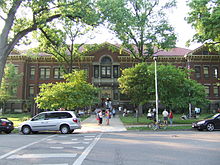
In the United states, Elementary school often includes kindergarten through quaternary, fifth, or sixth class; less normally, some elementary schools extend as far as 8th form[31] Eye schools and junior high schools are schools that span varying combinations of grades 5 to 8,[31] such as v–eight, half dozen–viii (near ordinarily), and 7–viii, and sometimes 7–9. Historically, local public control (and private alternatives) over education has immune for some variation in the arrangement of schools. Basic subjects are taught and pupils often remain in one or two classrooms throughout the schoolhouse day, except for physical education, library, music, fine art, and computer classes. In 2003, in that location were well-nigh 3.6 million children in each grade in the United States.[32]
The range divers by either is often based on demographic factors, such as an increase or decrease in the relative numbers of younger or older students, with the aim of maintaining stable school populations.[33] At this fourth dimension, pupils are given more than independence, moving to different classrooms for unlike subjects, which includes math, social studies, science, and language arts. Also, pupils are able to choose some of their course subjects (electives). Unremarkably, starting in sixth grade, grades become function of a educatee's official transcript.
The junior high schoolhouse concept was introduced in 1909, in Columbus, Ohio.[34] Junior loftier schools were created for "bridging the gap betwixt the elementary and the high school", an emphasis credited to Charles W. Eliot.[35] In the tardily 19th century and early 20th century, near American elementary schools had grades 1 through 8, and this system still exists, where some concepts of middle school organisation have been adjusted to the intermediate grades. As time passed, the junior high school concept increased quickly equally new school districts proliferated, or systems modernized buildings and curricula. This expansion continued through the 1960s. Jon Wiles, author of Developing Successful Thou–8 Schools: A Principal's Guide, said that "a major problem" for the original model was "the inclusion of the ninth course", because of the lack of instructional flexibility, due to the requirement of having to earn loftier school credits in the ninth grade and that "the fully boyish ninth grader in junior high school did not seem to belong with the students experiencing the onset of puberty".[36]
The new middle school model began to appear in the mid-1960s. Wiles said, "At showtime, it was difficult to make up one's mind the difference between a junior high school and a middle schoolhouse, just equally the heart school became established, the differences became more than pronounced".[36] Middle school is in between elementary school and loftier school, and has sixth- to 8th-graders. Junior high schools prepare 7th, 8th, and, in some districts, 9th grade students for high school.[ citation needed ]
The kinesthesia is organised into academic departments that operate more or less independently of one another.[ commendation needed ]
The middle school format has now replaced the junior high format by a ratio of nearly ten to one in the United states of america,[ citation needed ] but some school districts incorporated both systems.
Uruguay [edit]
In Uruguay, the public center school consists of two stages, one mandatory called "Basic Cycle" or "Offset Cycle". This consists of iii years, ages 12–13, 13–14 and 14–fifteen (equivalent to American 7th, 8th, and 9th grades), and one optional chosen "Second Cycle", ages 15–16, 16–17 and 17–18 (equivalent to American tenth, 11th, and 12th grades). The Second Wheel is divided into iv options in the Uruguayan fifth class: "Homo Sciences", "Biological science", "Scientific" and "Arts", and 7 options in the 6th and last class: "Law" or "Economy" (if Human Sciences course taken in 5th), "Medicine" or "Agronomy" (if Biological course taken in 5th), "Compages" or "Engineering" (if Scientific course taken in fifth) and "Arts" (if Arts class taken in 5th).
Both these stages are commonly known as "Liceo" (Spanish for "high schoolhouse").
Venezuela [edit]
In Venezuela, middle schools ( educación media general , ages 12–15) are from 7th class to 9th grade.
In some institutions called "Technical Schools" there is an extra class, for those who want to graduate every bit "Middle technician" in a certain surface area. This teaching would allow them to be hired at a higher level, or get introduced more than hands into a college career.
Vietnam [edit]
Secondary school, or Junior High school, includes form half-dozen to 9. Afterwards finishing course nine, students take to take the national graduating test, which includes sections on Mathematics, Literature and English. The maximum score for each test is 10, with the first two subjects (chosen the Core Subjects) multiplied by two for a total possible score of 50. Advantage points from a vocational course could too be added to the final score.
Some public schools use graduating exam scores and student transcripts to brand their decisions. Many other public and private schools crave students who apply for those schools to take their entrance exams. The administration team educatee transcripts and exam scores to make up one's mind whether students are qualified based on their admissions criteria.
See also [edit]
- QuickSmart
- Virtual reality in primary teaching
Notes [edit]
- ^ Commonly referred as the "Middle Exam" (Simplified Chinese: 中考 ).
- ^ Pelajar Menengah Rendah
- ^ "chuzhong" (初級中學, 初中
- ^ "guozhong" (國民中學, 國中
References [edit]
- Specific citations
- ^ "Shake-up puts Year 7s in high school". WA Today. 8 December 2011.
- ^ "A Short HISTORY of THE ARMIDALE Schoolhouse" (PDF). The Armidale Schoolhouse. Archived from the original (PDF) on 2013-04-08. Retrieved 2014-01-sixteen .
- ^ "Well-nigh Middle Years". Middle Years – Northern Territory of Australia. Northern Territory Authorities. 200. Archived from the original on 2008-02-23. Retrieved 2008-02-01 .
- ^ "Ley de Reforma Educativa. Ley Nº 1565/1994 – OEI" [Educational Reform Law. Law No. 1565/1994 – OEI] (PDF). OEI.
- ^ "Definition of junior loftier school". Retrieved June 12, 2007. 2009-10-31.
- ^ a b Czech Act No. 561/2004 Collection of Law, on Pre-school, Basic, Secondary, Tertiary Professional and Other Education Archived 2014-06-27 at the Wayback Machine (the Teaching Act)
- ^ "Les niveaux et les établissements d'enseignement – Ministère de l'éducation nationale" [Educational levels and establishments – Ministry building of National Education] (in French). Education.gouv.fr. Archived from the original on 4 Oct 2006. Retrieved 2014-01-16 .
- ^ "Georgian educational system" (in Georgian). Retrieved 2018-09-14 .
- ^ "Schools Gibraltar | Colleges Gibraltar". Retrieved 2009-01-09 .
- ^ a b c Amaidi. "Indian Pedagogy System" (PDF). Archived from the original (PDF) on 17 June 2012. Retrieved v May 2012.
- ^ Middle school statistics between 2004–2005 "Archived copy". Archived from the original on 2007-09-27. Retrieved 2009-08-06 .
{{cite spider web}}: CS1 maint: archived re-create as title (link) - ^ Mehrabi, Masoud. "Iran Bedroom Social club: Instruction in Islamic republic of iran: The Iranian Educational System". Retrieved 2014-10-17 .
- ^ "Israel Education Organization".
- ^ "Schools/Homepage – Te Kete Ipurangi (TKI)" [Schools/Homepage – Internet Marketing (TKI)]. Archived from the original on 17 March 2018.
- ^ "Schools/Homepage – Te Kete Ipurangi (TKI)" [Schools/Homepage – Internet Marketing (TKI)].
- ^ "Schools/Homepage – Te Kete Ipurangi (TKI)" [Schools/Homepage – Internet Marketing (TKI)]. Archived from the original on 17 March 2018.
- ^ "Schools/Homepage – Te Kete Ipurangi (TKI)" [Schools/Homepage – Net Marketing (TKI)]. Archived from the original on 17 March 2018.
- ^ Romania, Ministry of National Pedagogy and Research (2014). "Changes in Didactics (Romanian version)". Education (No english version).
- ^ Chip Tv & Ziarulorizont.Info (2020-07-04). "14 ani de școală obligatoriu începând din toamnă! Reguli pentru înscrierea la clasa pregătitoare | BitTV.Info – PASCANI, TG. FRUMOS, HARLAU". BitTV.Info. Retrieved 2022-02-26 .
{{cite web}}: CS1 maint: multiple names: authors listing (link) - ^ "Список предметов, изучаемых в начальной, средней и старшей школе" [List of subjects studied in primary, secondary and high school.] (in Russian). Archived from the original on 2016-03-02. Retrieved 2016-02-19 .
- ^ "Учебные четверти и каникулы" [Written report quarters and vacations] (in Russian).
- ^ Ministry building of Education Science & Engineering. "Education System". Archived from the original on 17 May 2012. Retrieved 5 May 2012.
- ^ Government Information Office. "Taiwan's Educational Development and Present Situation". Archived from the original on 31 July 2012. Retrieved five May 2012.
- ^ Central Advisory Council for Education (England) (1967). "Volume ane Chapter x The Ages and Stages of Primary Educational activity". Children and their Primary Schools. Her Majesty'due south Jotter Office. Archived from the original on 2010-04-04. Retrieved 2008-02-01 .
- ^ a b "Middle schools pass up due to haphazard development". Times Educational Supplement. 1981-11-13. p. 9.
- ^ Andrew, Herbert; Department of Pedagogy and Scientific discipline (1965-07-12). "Primary forms of comprehensive organisation". Circular 10/65: The Organisation of Secondary Instruction. HMSO. Archived from the original on 2007-09-28. Retrieved 2009-04-18 .
- ^ "Education: End of the Heart Way?". BBC News. 1998-06-28. Retrieved 2008-02-01 .
- ^ "Great britain Middle Schools". Retrieved 2016-01-eleven .
- ^ "The Education (Middle School) (England) Regulations 2002". Statutory Instrument 2002 No. 1983. Her Majesty'due south Stationery Part. 2002. Retrieved 2008-02-01 .
- ^ Meldrum, James (1976). Three-tier Education in Grangemouth.
- ^ a b [1], p. 7, fig. 1
- ^ "Assimilate of Educational activity Statistics, 2001" (PDF) . Retrieved 2010-04-xiv .
- ^ junior high school. encarta.msn.com. Archived from the original on August 30, 2009. Retrieved July 24, 2007.
The major difference between a centre schoolhouse and a junior loftier lies in the philosophy. The middle school philosophy focuses on the student where the junior high focus is more on the content.
2009-ten-31. - ^ "First Junior High School in the Usa". OhioHistoryCentral.org. Ohio Historical Society. Retrieved 2014-08-19 .
- ^ "Junior high plan outlined", The Dallas Morning News, September 22, 1929, section 1, page 9.
- ^ a b Wiles, John, ed. (June 10, 2009). Developing Successful Thousand–8 Schools: A Principal's Guide. Corwin Press. p. 3. ISBN978-1412966177.
External links [edit]
- Canada: Provincial Systems of Teaching
- Association for Middle Level Instruction formerly National Middle Schoolhouse Clan.
- National Heart Schools' Forum (UK)
- Australian Eye School Program
Source: https://en.wikipedia.org/wiki/Middle_school
0 Response to "Everything You Need to Know About Us History Middleschool"
Post a Comment